
Fitness Personal Training Coach
Personal Training and Fitness Coaching: Are They Effective?
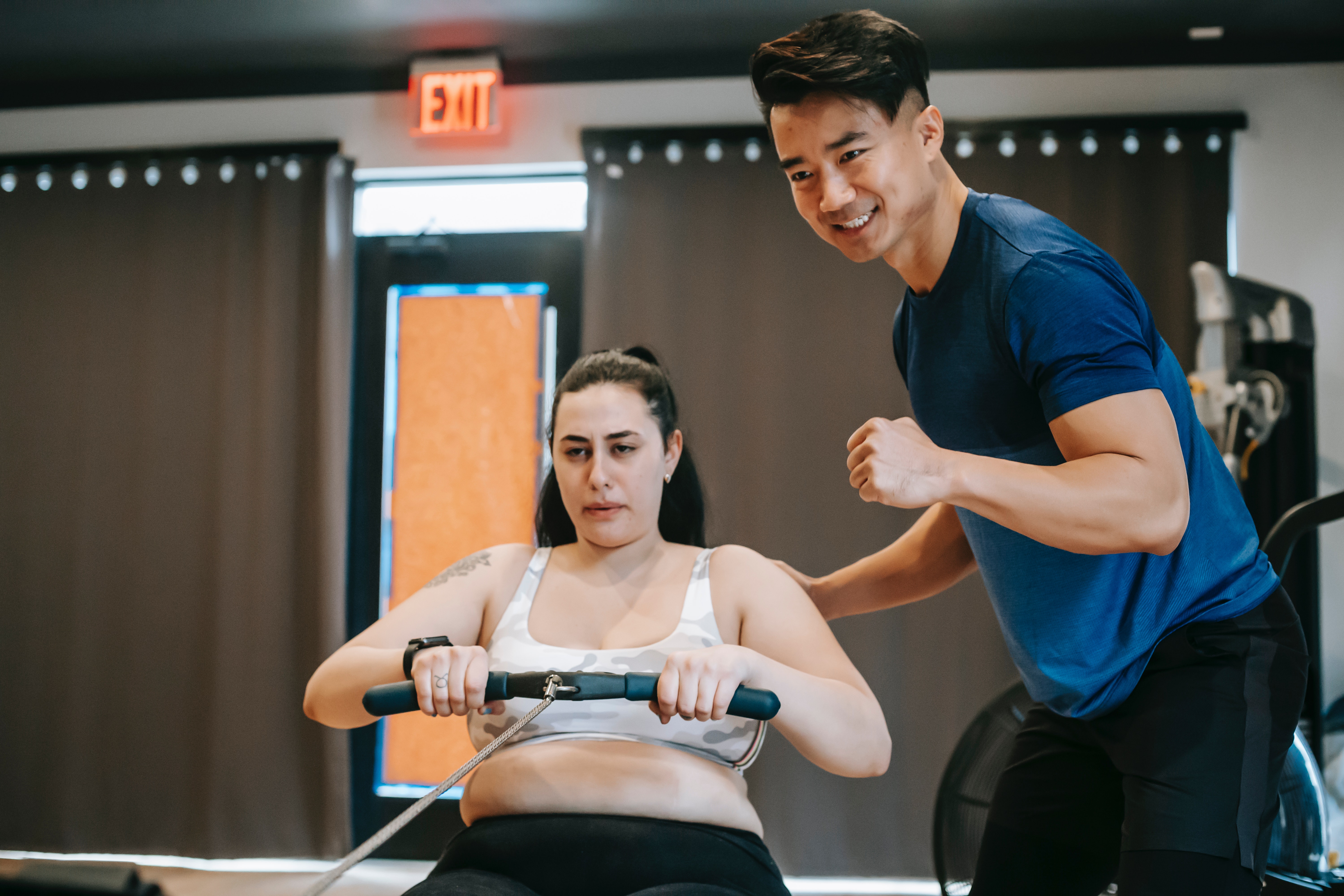
Personal training, with the exception of membership fees, generates the most income for fitness centers of any service. Certainly, the industry has grown dramatically over the last two decades, with consumers consistently ranking personal training as one of the top five services provided by health clubs. Surprisingly, little study has been conducted on the effectiveness of working with a personal trainer or fitness coach. Does it truly assist customers in reaching their health and fitness objectives?
Read More: How to gain muscle, no matter who you are
Without a doubt, the
majority of us in the fitness business would say yes—provided, of course, that
the trainer or coach was well-qualified and the client's goals were feasible.
However, this response is mostly based on anecdotal information. Personal
trainers' assessment focus is currently on the amount of monetary compensation
received for training sessions rather than the health outcomes gauging the
quality of program delivery to participants.
According to the trans
theoretical model, the minimal amount of published research on
personal-training results has mainly focused on biometric measures, exercise
adherence, or mobility through the phases of transformation (Prochaska and
Velicer, 1997). According to McClaran (2003), weekly sessions with a personal
trainer considerably boosted clients' capacity to go through the phases of
change in terms of physical activity. Over a 10-week period, 60 percent of
research participants advanced one level, while 13 percent advanced two stages,
suggesting evidence of health-behavior change. Personal training has also been
demonstrated to have a substantial influence on cardiovascular and muscular
strength increases. Mazzetti et al. (2000) discovered that supervised
(personally trained) individuals had higher training loads, 1RM, peak power
output, and fat-free mass than unsupervised participants. Furthermore, Adelphi
University researchers evaluated in-home and in-gym personal training and
discovered that both were beneficial in terms of weight reduction,
cardiovascular function, adherence, and motivation, with no difference between
the two (Sykes et al, 2007).
In terms of results,
fitness coaching [defined by Moore and Taschannen-Moran (2010) as assisting
clients in developing healthy living practices outside of scheduled exercise
sessions] has also received insufficient attention. Fitness coaching success is
often measured by better lifestyle modifications and decreased sickness and
disease. According to Chapman, Lesch, and Baun (2007), fitness coaching is
expected to become a mainstay of workplace health promotion practice, as
indicated by the number of worksite wellness programs that now undertake
health-risk assessments in conjunction with fitness/wellness coaching.
Fitness coaching,
particularly phone treatments, has been studied in adult populations and
appears to be useful in boosting fitness and exercise adherence. In terms of
enhanced functional ability and adherence, Castro and King (2002) determined
that home-based, telephone-supervised programs were equally successful as
group- or facility-based programs. It should be emphasized that each of these
trials included one face-to-face encounter prior to the telephone coaching
intervention. However, very little scientific evidence exists to explain how
and why fitness coaching is effective for improving healthy living practices.
The following study,
done by a team of researchers at Indiana University, was prompted by the
conspicuous absence of rigorous studies investigating the effectiveness of
personal training and fitness coaching. Researchers assessed how working with a
coach or trainer influenced the amount of time individuals spent sitting each
day, an important sign of future health concerns, in addition to monitoring
changes in health parameters such as body-fat percentage and VO2 (see sidebar).
Reduced Sedentary Behavior (i.e., Sitting Time)
An sedentary lifestyle
has been established as a risk factor for coronary heart disease, but new
research suggests that even with regular exercise, hours of sitting can harm
the body's metabolism, blood chemistry, and general physiology. Even when
people exercise on purpose, sickness and premature mortality tend to rise when
sitting time increases. In other words, while frequent activity throughout the
week is obviously healthy, it does not appear to totally counteract the
consequences of prolonged sitting (Katzmarzyk et al., 2009). Constant sitting,
according to the research, can lead to health problems and a shorter lifespan.
These discoveries have given rise to a new field of study known as
"inactivity physiology." When the muscles in the legs
"sit," they activate or repress numerous hormones that alter
triglycerides, cholesterol, and indicators for heart and other problems.
Non-exercise activity thermogenesis (NEAT) refers to the energy expended for
all activities other than sleeping, eating, and "sports-like
exercise" (Levine, 2004). Sitting time is encouraged by modern technology,
which, of course, diminishes NEAT. Many people in the United States, according
to studies, have "sitting illness" and would have reduced rates of
obesity and lifestyle-related disorders if NEAT were boosted. Most Americans
spend more than 70% of their waking hours working at a desk, driving, eating,
playing video games, or watching television. Sedentary behavior appears to be a
significant independent component of overall health and wellness. As a result,
limiting and/or breaking up sitting time should now be seen as a key public
health priority (Hamilton et al., 2008).
Personal Training and Fitness Coaching Effects on College Students
It is a well-known fact
that students acquire weight during their first year of college. This is due to
a combination of variables such as decreased physical activity, increased sedentary
behavior (i.e., sitting time), and poor dietary habits [American College Health
Association (ACHA), 2010]. Several studies have been conducted to investigate
the impact of treatments (such as health education and physical activity
classes) aimed at college students. However, few studies have been conducted to
demonstrate the efficacy of personal training and/or fitness coaching
strategies in the collegiate population. Furthermore, no previous research on
the amount of sitting time outside of personal training and fitness coaching
sessions have been conducted. There is little, if any, evidence that personal
training and fitness coaching are beneficial in increasing physical activity
while decreasing sedentary behavior (i.e., sitting time).
The goal of this
experiment was to evaluate personal training and fitness coaching by
quantifying sitting time in addition to usual biometric data. In an adult
cohort, Patel et al. (2010) found that time spent sitting was independently
related with overall mortality, regardless of physical activity levels. Would
there be changes in self-reported sitting-time patterns across these three
groups: those who worked with a personal trainer, those who worked with a
fitness coach, and those who exercised on their own? Personal trainers and
fitness coaches were undergraduate and graduate students enrolled in
fitness-related degree programs at the institution. Personal trainers created
30-minute fitness plans and visited with customers in person. Fitness coaches,
on the other hand, did not meet with customers in person; instead, they
corresponded with them regularly via email, texting, and phone conversations.
Fitness trainers were advised to provide lifestyle counseling rather than
particular workout regimes. The control group consisted of independent
exercisers.
It should be noted that
the clientele did not pay for personal training or fitness coaching. These were
supplied to students as a free service within their residential halls.






Leave a Reply